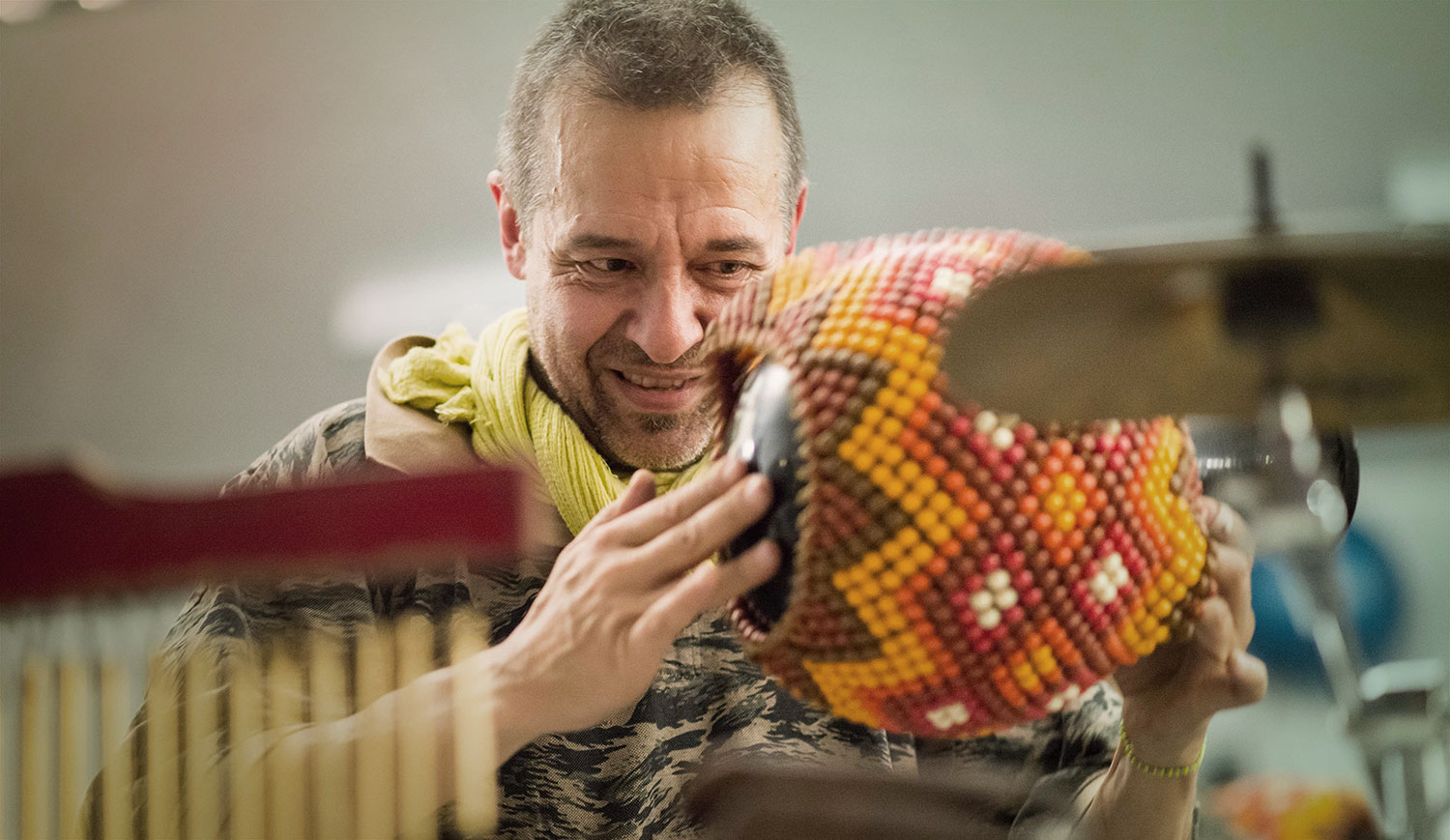
Nació en 1968 en Montevideo, Uruguay.
Comenzó a desarrollar su pasión por la música y la percusión cuando tomó contacto por primera vez con una batería a los once años; desde entonces su vida ha sido un largo viaje, a través de diferentes maestros, ritmos, países y culturas que hacen de su arte algo genuino, atravesando por la vivencia de cada instrumento y cultura nativa.
De los 11 a 18 años tomó clases de batería con Arturo Barros, Jose Luis Perez y Osvlado Fatorusso.
A los 19 años ingresó a la EUM, como alumno de la cátedra de percusión a cargo de Jorge Camiruaga, hasta los 23 años en que emprendió su primer viaje para profundizar sus estudios y formación.
Viajó a La Habana -Cuba, en 1992/93 formándose en música popular cubana y afrocubana en la Escuela Superior IGNACIO CERVANTES.
En 1995 viaja a Salvador de Bahía, donde estudia e intercambia ya en rol de docente en la OIM, Oficina de investigacao Musical, del pelourinho, tocando en interactuando con los más destacados ritmistas del momento en Bahia y dirigiendo el bloco KIZUMBA en el carnaval de 1996, comenzando allí la búsqueda de fusionar candombe con otros ritmos e instrumentos, experiencia que a su regreso explota de la mano del trabajo en los talleres de la IM y la incursión como pionero en la percusión alternativa en los talleres del Florencio Sanchez y después malvin, escuela 180, de donde surgio TRIBU MANDRIL y LATASONICA entre otros…
Al regresar de Bahia permanece 5 años en Uruguay con intensa actividad como ejecutante y docente, viajando en ese periodo a Paraguay a compartir la fiesta de SAN BALTASAR con la comunidad CAMBAKUA en las afueras de Asuncion y aprender lo que los negros que emigraron con Artigas tocan a cantan para el Santo Patrono de los Afro Uruguayos.
También en esa etapa viaja a Perú a profundizar los conocimientos del cajón peruano con la familia MUJICA, tomando clases y tocando con los más destacados percusionistas del momento en Peru, Chocolate Argendones, Cotito, Marcos Medrano, entre otros…
El siguiente paso en su formación fue el viajar a África del oeste, 2002, a aprender en el lugar donde las cosas realmente suceden, la música MALINKE en Guine Conakry con el gran maestro de Djembe ARAFAN TOURE y la música WOLOFF en Dakar Senegal con Babacar Seck, de Tam Tam magique de LA MEDINA, dejando la célula referencial a nuestra música negra, EL SEMBA ANGOLANO, para el cierre del viaje y en Portugal, ya que Angola estaba en guerra en esa altura…la información de culto a San Baltasar de los CAMBAKUA, así como la rítmica del SEMBA ANGOLANO, son los elementos más genuinos que pudo recabar en estos años de viajes e investigación sobre el origen de nuestra música negra, y al cual hacen referencia los más importantes musicólogos de la época, como el Sr Lauro Ayestaran, y forman parte de su programa de docencia como capítulo FUNDAMENTAL, al igual que lo aprendido en CADIZ años más tarde, sobre el origen de la murga y fundamentalmente el origen rítmico de nuestra batería ligado a lo que tocan las chirigotas y comparsas en los carnavales Gaditanos de la mano del pasodoble y el tango de Cádiz.
Su último viaje a Cuba nuevamente fue en el año 2015, a cerrar este recorrido de 25 años, en el primer país al que viajó con objetivos de aprendizajes musicales, esta vez con la intención profundizar y dar un paso más en lo que es el tambor mayor en la música afrocubana y todo lo que este implica, EL BATA, y dando también un paso desde el culto de dicho tambor y cultura, de la mano de referentes como Tony Urdaneta y Renecito Pedroso, prestigiosos tamboreros de la actualidad cubana.
Otro elemento agregado a sus herramientas, y que le ha sumado en el trabajo con grupos fue la formación que tuvo en Argentina con Santiago Vazquez , 2018,en el lenguaje de señas para dirigir ensambles de percusión en el CERPS. Este nuevo recurso lo viene utilizando en los ensambles de la EUM y la IM, siendo una herramienta de mucha utilidad y estímulo tanto para él como para los participantes.
Como docente trabaja a nivel particular hace 30 años, pero el viajar y compartir su recorrido y aprendizaje lo llevaron a dar clases en la UFIBA (universidad de música de Bahía), en el preuniversitario de Espinho de PORTUGAL, en la escuela LIVIKA de percusión de Madrid, España, y desde su regreso por última vez al uruguay en 2010, forma parte del equipo docente de la EUM, diseñando en 2021, por primera vez un tronco común entre la formación clásica y popular en el programa de la cátedra de percusión.
Ganó en 2018 el concurso para docente de la Escuela Esquinera de la IMM donde lleva adelante un trabajo de ensambles sumamente rico en contenidos musicales, fruto de lo cual surge LA CHASQUIBUM, su último formato en percusión y señas.
Ganó el concurso para docente interino en la cátedra de Percusión de la EUM en 2020, por mérito y oposición, formando parte de la cátedra oficialmente a partir del mismo, fruto de las buenas experiencias y frutos que los anteriores años (2010 a 2019)en calidad de contratado adjunto habían generado.
Ganó en 2022 el concurso para ritmista de la orquesta de UTU, por mérito y oposición, donde se desempeña como percusionista y baterista.
En todos estos años de búsqueda y creación ha tenido la posibilidad de tocar y grabar con grandes artistas como: Rubén Rada, Diego Torres, Luis Salinas, Hugo y Osvaldo Fattoruso,Mariana Ingold, Jorge Drexler, Luciano Supervielle, Juan Campodónico,Kevin Johansen entre muchos otros.
También su interés por lo más popular de nuestra cultura musical, el Carnaval, lo llevaron a participar en los 2 géneros rítmicos por excelencia, Candombe y Murga,obteniendo varios reconocimientos junto a La Calenda, Sinfonía de Ansina, Zumbae, Lonjas de Cuareim, (formó parte de la cuerda de tambores tocando y también en la composición del arreglo de la misma en el regreso en las llamadas en 2023 de la legendaria comparsa de barrio Sur LONJAS DE CUAREIM, reubicando la comparsa entre las 10 mejores, tanto en el global como en la cuerda de tambores) Agarrate Catalina y Acontramano.
En sus proyectos, como solista, destacamos algunos de sus creaciones y formatos:
- La Sandunguera: banda pionera en fusionar rítmicas afrocubanas con afro uruguayas, a su regreso del primer viaje a Cuba.
- Tribu Mandril: grupo pionero en percusión alternativa, a su regreso de Salvador de Bahía.
- Ofrenda: proyecto a dúo con Ariel Ameijenda fusionando la textura en instrumentos de oriente con la percusión menor y el inicio de la investigación sonora y la tecnología en la misma( primer eslabón de SUPERPLUGGED).
- Los Carnavales del Mundo: formato a trío (Batería, Bajo y Teclado) que presenta composiciones propias y reversiones de temas clásicos de dicha fiesta popular en éstas y otras latitudes donde, desde la música instrumental suenan las rítmicas más reconocidas de los diferentes carnavales del mundo.
- SuperPlugged: un proyecto totalmente innovador, donde la tecnología está al servicio de lo más primitivo de diferentes percusiones de distintas culturas, con el agregado de que el público escucha por auriculares, generando un repertorio y ambiente único.( dicho show tuvo 10 temporadas de suceso en los dos teatros más importante del país, TEATRO SOLIS, AUDITORIO DEL SODRE).
- BPM, La Jaula del Ritmo: juntando la labor de docente en la EUM, la influencia y gusto por la percusión alternativa, y lo más sustancial de percusiones de nuestras latitudes, surge este ensamble de percusión, con características musicales y estéticas muy potentes. En esta propuesta la fusión del rol de docente y músico se plasman como nunca antes ya que el grupo se genera desde la experiencia con los alumnos de la EUM y tiene su principal escenario la explanada de la misma como desafío para unir el proceso creativo y de acabado de un show con el ponerlo en escena en un ambiente cambiante e inesperado como es la del arte callejero…
- AFRO BEATS: proyecto a duo , basado en el origen negro de la ritimica de los mas importantes generos musicales de la actualidad, desplegando en este caso desde el set de percusión su performance.
- LA CHASQUIBUM: grupo de percusión que surge del trabajo como docente de la escuela esquinera, integrado solamente por alumnos, la gran mayoría en su primer año de encuentro con la percusión, generando un estímulo y disparador más que genuino para públicos que se ven reflejados en pares llevando adelante un show de alta intensidad y contenido.
- LA COVID: sala que diseñó en el periodo de la pandemia en su casa, donde durante los 2 años que duró la misma, y con las precauciones sanitarias correspondientes mantuvo la actividad en formato de ENSAYOS ABIERTOS, con actividad semanal y sin costo, permitiendo así a los proyectos Carnavales del Mundo, Afro Beats y Brasil Power Trio, mantener la dinámica de tocar con público y a la gente cercana a los proyectos, participar de actividades que en su momento se paralizaron, acceder a las mismas con un formato diferente dado el ida y vuelta que con un CONCIERTO DIDÁCTICO o ENSAYO ABIERTO se da…esto sucedió y sigue sucediendo en LA COVID y es gratuito, sin ningún tipo de retribución económica, más que la posibilidad de tocar y abrir ensayos y procesos creativos para el artista y al público el poder formar parte del mismo desde adentro pudiendo preguntar e involucrarse con un show desde adentro.
- MUNDO ARNICHO: programa de radio que plasma el recorrido musical y vivencial del artista desde lo rítmico, con referencias musicales y ejemplos prácticos y teóricos que se emite en las radios del SODRE semanalmente desde 2024 y es resultado del vínculo que desde 2010 tiene con participaciones en contenidos didácticos constantemente en la programación de dicha emisora.
TRABAJOS EDITADOS:
- LA MENTE EN NEGRO, trabajo discográfico editado por Ayui en 1992.
- SYNCOPATA, libro de batería, editado en 1995.
- TRIBU MANDRIL, trabajo discográfico editado por Mandril Music, 1997.
- OFRENDA, trabajo discográfico editado por el departamento de cultura de la IMM, 1998.
- TOCALATA, trabajo discográfico editado por Ayui, 2000.
- RAL, trabajo discográfico editado por Tero Verde, 2005.
- BATUKES Y BATIDAS, trabajo discográfico editado por MMG, 2007.
- GLOBAL RHYTHM, dvd didáctico editado por MMG, 2008.
- CONFESIONES, trabajo discográfico editado por MMG, 2009.
- CARNAVALES DEL MUNDO, dvd editado por MMG, 2010.
- SUPERPLUGGED, dvd editado por MMG, 2012.
- CARNAVALES DEL MUNDO II, material digital, editado por Mandril Music, 2014.
- SUPERPLUGGED II, material digital, editado por Mandril Music, 2015.
- LA JAULA DEL RITMO, material digital, editado por Mandril Music, 2016.
- LA CHASQUIBUM, material digital editado por Mandril Music 2019.
- AFRO BEATS, material digital editado por Mandril Música 2020.
- EL RITMO COMO ENTRETENIMIENTO (contenido didáctico para uso general en la docencia), material digital editado por Mandril Music, 2022.
- CARNAVALES DEL MUNDO III, material digital editado por Mandril Music, 2024.
- MORA CANDOMBE (pieza de percusión CONTEMPORÁNEA compuesta por el artista basada puramente en el toque de los 3 tambores en un contexto ACADÉMICO), material digital editado por Mandril Music, 2025.
Born in 1968 in Montevideo, Uruguay.
He began developing his passion for music and percussion when he first came into contact with a drum set at the age of eleven; since then, his life has been a long journey through different teachers, rhythms, countries, and cultures, all of which have shaped his art into something truly authentic, enriched by the lived experience of each instrument and native culture.
From ages 11 to 18, he studied drums with Arturo Barros, Jose Luis Perez, and Osvlado Fatorusso.
At age 19, he entered the EUM as a student in the percussion department under the direction of Jorge Camiruaga, remaining there until age 23, when he embarked on his first journey to deepen his studies and training.
He traveled to Havana, Cuba, in 1992/93, where he studied Cuban popular and Afro-Cuban music at the Escuela Superior IGNACIO CERVANTES.
In 1995, he traveled to Salvador de Bahía, where he studied and exchanged knowledge—already in the role of teacher—at the OIM (Oficina de Investigação Musical) in Pelourinho, performing and interacting with some of Bahia’s most outstanding rhythmists. He also directed the bloco KIZUMBA during the 1996 Carnival. It was there that he began exploring the fusion of candombe with other rhythms and instruments, an experience he later developed upon returning to Uruguay through workshops at the IM and as a pioneer of alternative percussion in workshops at Florencio Sánchez and later Malvín, Escuela 180, from which TRIBU MANDRIL and LATASONICA emerged, among others.
After returning from Bahia, he remained in Uruguay for five years with intense activity as both performer and teacher. During this period, he traveled to Paraguay to participate in the SAN BALTASAR celebration with the CAMBAKUA community on the outskirts of Asunción, learning the music and songs performed by the descendants of Black Uruguayans who migrated with Artigas in honor of the patron saint of Afro-Uruguayans.
During this same period, he also traveled to Peru to deepen his knowledge of the Peruvian cajón with the MUJICA family, taking lessons and performing with some of Peru’s most distinguished percussionists of the time, including Chocolate Argedones, Cotito, and Marcos Medrano, among others.
The next step in his musical development was traveling to West Africa in 2002 to learn where these traditions truly originate: MALINKE music in Guinea Conakry with the great djembe master ARAFAN TOURE, and WOLOFF music in Dakar, Senegal, with Babacar Seck of Tam Tam Magique de LA MEDINA. He reserved the study of the ANGOLAN SEMBA—an essential reference for Afro-Uruguayan music—for the end of the journey, pursuing it in Portugal, as Angola was at war at the time. The knowledge he gathered about the San Baltasar worship among the CAMBAKUA, as well as the rhythmic structure of ANGOLAN SEMBA, became some of the most authentic elements of his research into the origins of Afro-Uruguayan music. These are also referenced by major musicologists such as Lauro Ayestarán and form a FUNDAMENTAL part of his teaching program, along with what he later learned in Cádiz about the origins of murga and, especially, the rhythmic roots of Uruguay’s drum corps, linked to the music performed by chirigotas and comparsas during the Cádiz Carnival through the pasodoble and the tango de Cádiz.
His most recent trip to Cuba was in 2015, completing a 25-year journey by returning to the first country he visited with the goal of musical learning. This time, he focused on deepening his understanding of the master drum of Afro-Cuban music and all it represents: EL BATA. He also further explored the spiritual and cultural traditions surrounding this drum under the guidance of respected masters such as Tony Urdaneta and Renecito Pedroso, two of today’s most prestigious Cuban drummers.
Another skill added to his toolkit, which has greatly enriched his group work, was the training he received in Argentina with Santiago Vazquez in 2018, studying sign language for conducting percussion ensembles at CERPS. He has since applied this resource in EUM and IM ensembles, finding it to be an invaluable and stimulating tool both for himself and for participants.
As a teacher, he has worked privately for 30 years. His travels and the sharing of his knowledge have also led him to teach at UFIBA (Bahia University of Music), the pre-university program in Espinho, Portugal, and the LIVIKA percussion school in Madrid, Spain. Since his final return to Uruguay in 2010, he has been part of the teaching staff at EUM, where in 2021 he designed, for the first time, a common curriculum bridging classical and popular training within the percussion department.
In 2018, he won the teaching competition for Escuela Esquinera of the IMM, where he leads highly enriching ensemble work with strong musical content, from which LA CHASQUIBUM emerged, his latest percussion-and-sign-language format.
In 2020, he won the competitive selection process to become interim professor in the EUM Percussion Department, officially joining the faculty as a result of the strong outcomes and successful experiences generated during the previous years (2010–2019), when he worked as an adjunct contracted instructor.
In 2022, he won the competitive selection process to become a rhythmist in the UTU orchestra, where he performs as percussionist and drummer.
Throughout these years of exploration and creation, he has had the opportunity to perform and record with great artists such as: :contentReference[oaicite:0]{index=0}, :contentReference[oaicite:1]{index=1}, :contentReference[oaicite:2]{index=2}, Hugo and Osvaldo Fattoruso, :contentReference[oaicite:3]{index=3}, :contentReference[oaicite:4]{index=4}, :contentReference[oaicite:5]{index=5}, :contentReference[oaicite:6]{index=6}, and :contentReference[oaicite:7]{index=7}, among many others.
His passion for the most popular expressions of Uruguayan musical culture—Carnival—also led him to participate in its two foremost rhythmic genres, Candombe and Murga, earning multiple recognitions alongside La Calenda, Sinfonía de Ansina, Zumbae, Lonjas de Cuareim (where he participated both as a drummer and arranger during the legendary Barrio Sur comparsa’s return to Las Llamadas in 2023, helping place the group among the top 10 both overall and in the drum section), Agarrate Catalina, and Acontramano.
Among his solo projects, some of his most notable creations and formats include:
- La Sandunguera: a pioneering band in the fusion of Afro-Cuban and Afro-Uruguayan rhythms, created after his first trip to Cuba.
- Tribu Mandril: a pioneering alternative percussion group formed after his return from Salvador de Bahía.
- Ofrenda: a duo project with Ariel Ameijenda, blending the textures of Eastern instruments with small percussion, marking the beginning of his exploration of sound and technology (the first link in what would become SUPERPLUGGED).
- Los Carnavales del Mundo: a trio format (Drums, Bass, and Keyboard) presenting original compositions and reinterpretations of classic Carnival themes from various regions, bringing to life the most recognizable rhythms from carnivals around the world through instrumental music.
- SuperPlugged: a completely innovative project where technology serves the most primal essence of percussion from different cultures, with the added feature that the audience listens through headphones, creating a unique sonic environment and repertoire. (The show ran successfully for 10 seasons at the country’s two most important theaters: TEATRO SOLIS and AUDITORIO DEL SODRE.)
- BPM, La Jaula del Ritmo: combining his teaching work at EUM, his passion for alternative percussion, and the essence of Latin American percussion, this percussion ensemble emerged with powerful musical and aesthetic characteristics. In this project, the fusion of teacher and musician reaches a new level, as the group originated from work with EUM students and performs primarily in the institution’s esplanade, where the creative process and polished performance meet the unpredictable environment of street art.
- AFRO BEATS: a duo project centered on the African roots of the rhythmic foundations of today’s most important musical genres, performed through his percussion setup.
- LA CHASQUIBUM: a percussion ensemble born from his teaching work at Escuela Esquinera, composed entirely of students, most of them in their first year of percussion study, creating a genuine source of inspiration for audiences who see themselves reflected in peers delivering an intense, high-content performance.
- LA COVID: a venue he designed in his home during the pandemic. Throughout the two years of restrictions, and with appropriate health precautions, he maintained artistic activity through OPEN REHEARSALS held weekly and free of charge, allowing projects such as Carnavales del Mundo, Afro Beats, and Brasil Power Trio to continue performing with audiences. This format gave audiences access to experiences that had otherwise been suspended, through the interactive dynamic of a DIDACTIC CONCERT or OPEN REHEARSAL. This initiative continues today, free of charge, with no financial compensation, driven solely by the opportunity to perform and share creative processes from the inside.
- MUNDO ARNICHO: a radio program reflecting the artist’s musical and personal journey through rhythm, featuring musical references and practical and theoretical examples. Broadcast weekly on SODRE radio stations since 2024, it is the result of a long-standing relationship with the broadcaster, for which he has contributed educational content since 2010.
RELEASED WORKS:
- LA MENTE EN NEGRO, album released by Ayui in 1992.
- SYNCOPATA, drum method book, published in 1995.
- TRIBU MANDRIL, album released by Mandril Music, 1997.
- OFRENDA, album released by the IMM Department of Culture, 1998.
- TOCALATA, album released by Ayui, 2000.
- RAL, album released by Tero Verde, 2005.
- BATUKES Y BATIDAS, album released by MMG, 2007.
- GLOBAL RHYTHM, educational DVD released by MMG, 2008.
- CONFESIONES, album released by MMG, 2009.
- CARNAVALES DEL MUNDO, DVD released by MMG, 2010.
- SUPERPLUGGED, DVD released by MMG, 2012.
- CARNAVALES DEL MUNDO II, digital release by Mandril Music, 2014.
- SUPERPLUGGED II, digital release by Mandril Music, 2015.
- LA JAULA DEL RITMO, digital release by Mandril Music, 2016.
- LA CHASQUIBUM, digital release by Mandril Music, 2019.
- AFRO BEATS, digital release by Mandril Music, 2020.
- EL RITMO COMO ENTRETENIMIENTO (educational content for general teaching use), digital release by Mandril Music, 2022.
- CARNAVALES DEL MUNDO III, digital release by Mandril Music, 2024.
- MORA CANDOMBE (a CONTEMPORARY percussion piece composed by the artist, based purely on the interplay of the three candombe drums within an ACADEMIC context), digital release by Mandril Music, 2025.